10AM - 4PM
 Free
Free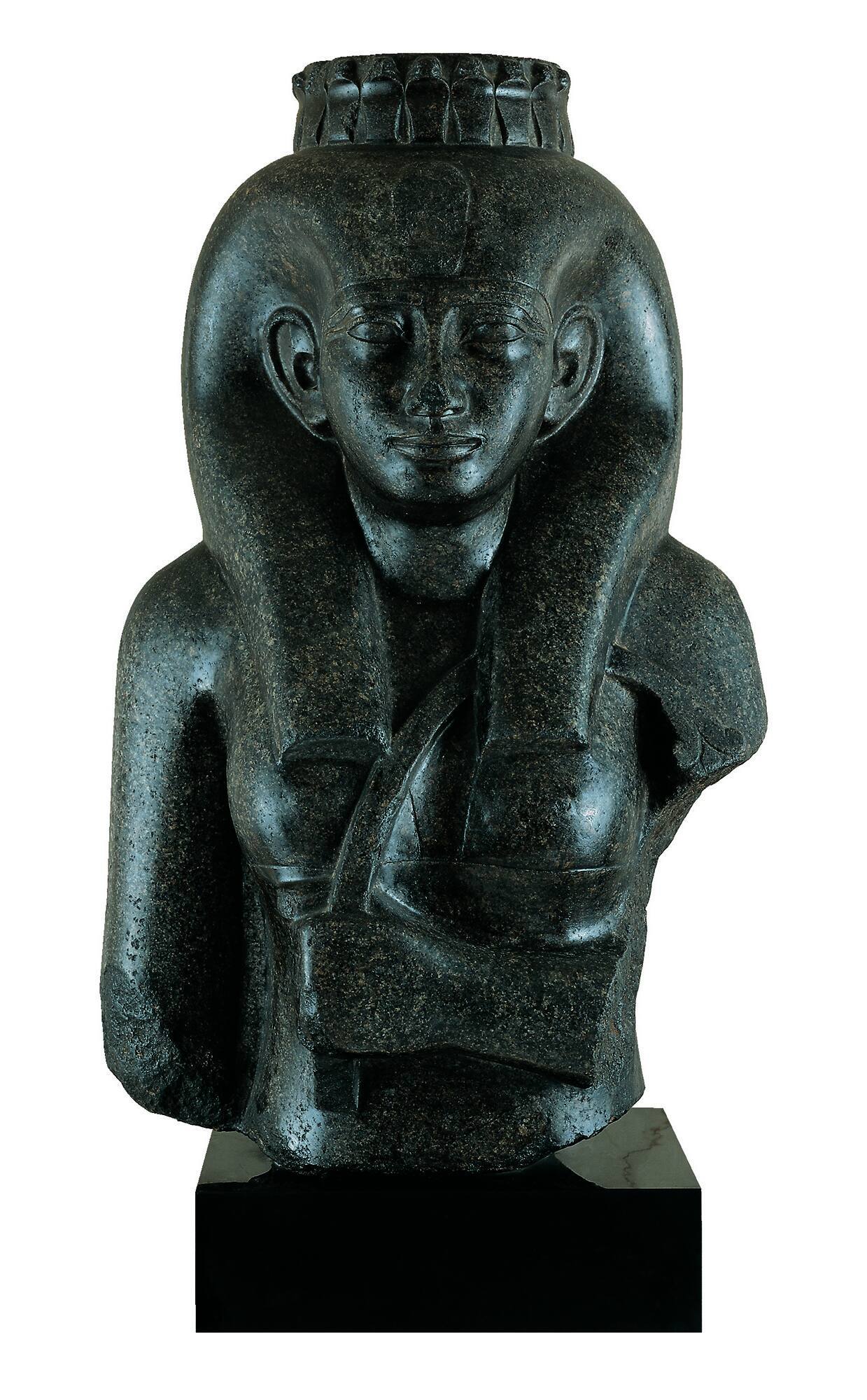

Amenirdas I, the Divine Consort
Egyptian
Title
Amenirdas I, the Divine Consort
Artist
Unknown Artist (Egyptian)
Date
25th Dynasty, c. 700 BCE
Medium
granite
Dimensions
33 × 15 × 12 in. (83.8 × 38.1 × 30.5 cm)
Classification
Sculpture
Credit Line
Museum purchase
Object Number
1953.80
On View
On view
Provenance
Probably from Thebes, Egypt [1];
General Jean-Léonard-François Le Marois (1776–1836), Paris, by 1800–1836;
By descent through the Le Marois family, Normandy, after 1836 [2];
Purchased from the great grandson of Jean-Léonard-François Le Marois by Paul Mallon (1884–1975), dealer, New York, by 1951–April 6, 1953 [3];
His sale to Joslyn Art Museum, Omaha, Nebraska, 1953.
[1] Bernard V. Bothmer, Egyptian Sculpture of the Late Period, 700 B.C. to A.D. 100 (New York: The Brooklyn Museum, 1960), 1.
[2] Correspondence from Anne El-Omami to Brooks Joyner, dated January 8, 2007, Joslyn Art Museum, Object File.
[3] Letter from Paul Mallon’s stepson William Girod to Eugene Kingman, March 21, 1952, “It [the sculpture] was brought back from Egypt by General Le Marois (later made Comte Le Marois) during Bonaparte’s campaign and stayed in the Le Marois family in Normandie until we acquired it from his descendant.” An undated catalogue sheet further specifies, “Acquired by Paul Mallon From Le Marois Great Grandson,” Joslyn Art Museum, Object File. Jean Le Marois had five great grandsons, four survived into the twentieth century: Henri-Amédée de Broglie (February 8, 1849–November 5, 1917), Francois Marie Albert de Broglie (December 16, 1851–April 4, 1939), Victor de Broglie (October 30, 1846–August 26, 1906), Cesar-Paul-Emmanuel de Broglie (April 22, 1854–July 2, 1926).
General Jean-Léonard-François Le Marois (1776–1836), Paris, by 1800–1836;
By descent through the Le Marois family, Normandy, after 1836 [2];
Purchased from the great grandson of Jean-Léonard-François Le Marois by Paul Mallon (1884–1975), dealer, New York, by 1951–April 6, 1953 [3];
His sale to Joslyn Art Museum, Omaha, Nebraska, 1953.
[1] Bernard V. Bothmer, Egyptian Sculpture of the Late Period, 700 B.C. to A.D. 100 (New York: The Brooklyn Museum, 1960), 1.
[2] Correspondence from Anne El-Omami to Brooks Joyner, dated January 8, 2007, Joslyn Art Museum, Object File.
[3] Letter from Paul Mallon’s stepson William Girod to Eugene Kingman, March 21, 1952, “It [the sculpture] was brought back from Egypt by General Le Marois (later made Comte Le Marois) during Bonaparte’s campaign and stayed in the Le Marois family in Normandie until we acquired it from his descendant.” An undated catalogue sheet further specifies, “Acquired by Paul Mallon From Le Marois Great Grandson,” Joslyn Art Museum, Object File. Jean Le Marois had five great grandsons, four survived into the twentieth century: Henri-Amédée de Broglie (February 8, 1849–November 5, 1917), Francois Marie Albert de Broglie (December 16, 1851–April 4, 1939), Victor de Broglie (October 30, 1846–August 26, 1906), Cesar-Paul-Emmanuel de Broglie (April 22, 1854–July 2, 1926).
Exhibition History
Egyptian Sculpture of the Late Period, Brooklyn Art Museum, October 18, 1960–January 9, 1961, no. 1.
Mistress of House, Mistress of Heaven: Women in Ancient Egypt, Cincinnati Art Museum, October 19, 1996–January 1997.
When the Greeks Ruled Egypt, Institute for the Study of the Ancient World, New York University, October 8, 2014–January 4, 2015; Art Institute of Chicago, October 31, 2013–July 27, 2014.
Mistress of House, Mistress of Heaven: Women in Ancient Egypt, Cincinnati Art Museum, October 19, 1996–January 1997.
When the Greeks Ruled Egypt, Institute for the Study of the Ancient World, New York University, October 8, 2014–January 4, 2015; Art Institute of Chicago, October 31, 2013–July 27, 2014.
Published References
Bernard V. Bothmer, Egyptian Sculpture of the Late Period, 700 B.C. to A.D. 100, exh. cat. (New York: The Brooklyn Museum, 1960), 1, 101, (repro.).
“Granite Goddess Really a Princess,” Omaha World-Herald, June 12, 1958, (repro.).
Philip Gurney, “Early Egyptian Culture Included Works of Art,” Dundee and West Omaha Sun, March 2, 1961, 26, (repro.).
Kunstwerke der Antike. Auktion XXII, May 13th, 1961 – Bronzen, Keramik, Skulpturen, Goldschmuck (Basel, Switzerland: Munzen Und Medaillen, 1961), 114.
Bernard V. Bothmer, “A New Field of Sculpture of the Late Period,” Connoisseur Yearbook (1962): 1, (repro.).
Great Art Treasures in America’s Smaller Museums (New York: G. P. Putnam’s Sons, 1967), 117.
R. S. Bianchi, “Napatan and Meroitic Sculpture: An Art Historical Reappraisal,” in Nubian Studies: Proceedings of the Symposium for Nubian Studies, Selwyn College, Cambridge 1978 ed. J.M. Plumley (Warminster, England: Aris & Phillips, 1978), 41–45, (repro.).
Donadoni Sergio, L’Egitto (Torino: UTET, 1981), 245, (repro.).
Barbara S. Lesko, “Women’s Monumental Mark on Ancient Egypt,” Biblical Archeologist 54 (1991): 4–15, (repro.).
Anne K. Capel and Gleen E. Markoe, Mistress of House, Mistress of Heaven: Women in Ancient Egypt (Cincinnati: Cincinnati Art Museum, 1996), 115–117, (repro.).
Bernard V. Bothmer and Madeleine E. Cody, Egyptian Art: Selected Writings of Bernard V. Bothmer (New York: Oxford University Press, 2002), 143, (repro.).
Roberta Casagrande-Kim, When the Greeks Ruled Egypt: From Alexander The Great To Cleopatra (New York: Institute for the Study of the Ancient World, New York University, 2014), 95, (repro.).
“Granite Goddess Really a Princess,” Omaha World-Herald, June 12, 1958, (repro.).
Philip Gurney, “Early Egyptian Culture Included Works of Art,” Dundee and West Omaha Sun, March 2, 1961, 26, (repro.).
Kunstwerke der Antike. Auktion XXII, May 13th, 1961 – Bronzen, Keramik, Skulpturen, Goldschmuck (Basel, Switzerland: Munzen Und Medaillen, 1961), 114.
Bernard V. Bothmer, “A New Field of Sculpture of the Late Period,” Connoisseur Yearbook (1962): 1, (repro.).
Great Art Treasures in America’s Smaller Museums (New York: G. P. Putnam’s Sons, 1967), 117.
R. S. Bianchi, “Napatan and Meroitic Sculpture: An Art Historical Reappraisal,” in Nubian Studies: Proceedings of the Symposium for Nubian Studies, Selwyn College, Cambridge 1978 ed. J.M. Plumley (Warminster, England: Aris & Phillips, 1978), 41–45, (repro.).
Donadoni Sergio, L’Egitto (Torino: UTET, 1981), 245, (repro.).
Barbara S. Lesko, “Women’s Monumental Mark on Ancient Egypt,” Biblical Archeologist 54 (1991): 4–15, (repro.).
Anne K. Capel and Gleen E. Markoe, Mistress of House, Mistress of Heaven: Women in Ancient Egypt (Cincinnati: Cincinnati Art Museum, 1996), 115–117, (repro.).
Bernard V. Bothmer and Madeleine E. Cody, Egyptian Art: Selected Writings of Bernard V. Bothmer (New York: Oxford University Press, 2002), 143, (repro.).
Roberta Casagrande-Kim, When the Greeks Ruled Egypt: From Alexander The Great To Cleopatra (New York: Institute for the Study of the Ancient World, New York University, 2014), 95, (repro.).